


October 8, 2026
Oligonucleotides look simple, until they are not. A basic sequence can be compact and easy to understand, but therapeutic oligonucleotides are far more complex. Therapeutic oligonucleotides often include modified sugars, altered backbone linkages, modified bases, terminal conjugates, duplexes, hairpins, strand breaks, and other structural features that directly influence how the molecule behaves.
Capturing that complexity requires more than registering a sequence. It requires a representation that preserves both biological meaning and chemical detail.
A sequence is not always a structure
Sequences communicate order and identity clearly. But modern oligos are defined as much by their chemistry as by their base sequence.
Modifications to bases, sugars, and backbones affect potency, stability, delivery, and selectivity. Conjugates and structural features such as duplexes or hairpins add additional layers of function.
Consider a typical GalNAc-siRNA: two strands with a mix of 2'-F and 2'-OMe sugars, phosphorothioate linkages at the termini, and a triantennary GalNAc ligand on the 3' end of the sense strand. In a spreadsheet, that's at least two strings of letters and a footnote. As a registered entity in CDD Vault, every modification, every linkage, and the conjugate are part of the structure itself.
To fully understand and work with these molecules, teams need a representation that captures both the sequence and the underlying chemistry in a structured, computable way.
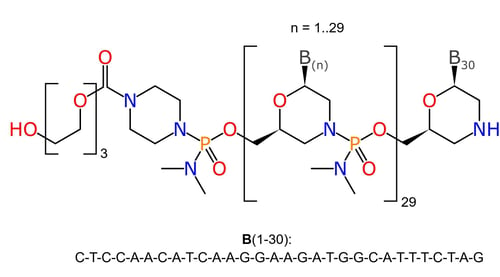 Eteplirsen, an example of a modified oligonucleotide, preserves the naturally occurring DNA bases but substitutes the sugar/phosphate backbone with heavy modifications
Footnotes do not scale
Footnotes are useful in papers, slide decks, and quick project discussions. They are not a strong foundation for a scientific system of record.
At a small scale, a team may be able to remember what every abbreviation means. A handful of modified oligos can be tracked in a spreadsheet or described in a shared document. But as a program grows, the cracks start to show.
Different scientists may use slightly different shorthand for the same modification. Similar oligos may be registered with different notation conventions. Custom modifications may be defined in one place but referenced in another. Attachments and conjugates may be described in comments rather than represented directly. This creates problems downstream.
For example, under traditional data capture workflows, a search for every 2'-MOE gapmer misses the ones registered under different shorthand. The same oligo gets registered twice under two notations, splitting its assay data across two records. The molecular weight and other downstream calculated properties from the base sequence ignore the modifications, resulting in inaccurate values. On the human side, when the scientist who defined a custom modification leaves, the meaning of the abbreviation might leave with them.
What chemically aware registration enables
CDD Vault’s chemically aware oligonucleotide registration brings sequence and structure together in a single, unified representation.
Instead of separating biological notation from chemical detail, it allows teams to:
- Represent modified bases, sugars, and backbone linkages directly
- Capture terminal modifications and conjugated groups as part of the structure
- Define duplexes, hairpins, scrunchies, and multi-strand constructs
- Include strand breaks and nonstandard connectivity
- Register complex conjugates involving peptides, antibodies, lipids, or small molecules
- Register custom monomer libraries to support project-specific chemistry
This approach ensures that the registered entity reflects what was actually designed and tested.
Multiple views, one entity
A key advantage of chemically aware registration is flexibility in how molecules are viewed.
Scientists can interact with the same oligo in different ways depending on their needs:
- A sequence view for quick interpretation or downstream bioinformatics workflows
- A chemically annotated representation for understanding modifications
- An expanded structure for calculation and search
These are not separate records or approximations. They are different views of the same underlying entity, preserving consistency across disciplines.
Better data, better discovery
When oligonucleotides are registered with full chemical awareness, the data becomes far more useful.
Teams can:
- Search for analogs based on structural features or modifications
- Compare molecules across programs with confidence
- Calculate properties directly from the registered structure
- Analyze structure–activity relationships more effectively
- Identify duplicates and related compounds accurately
That means a scientist can find every oligo in the Vault that shares a modification pattern, and trust that its assay results belong to the molecule that was actually tested.
Register the molecule as it exists
The goal of modern oligonucleotide registration is straightforward: represent the molecule as it actually exists with its sequence, chemistry, connectivity, and structure readable, searchable, and computable. Chemically aware registration makes this possible by unifying biological and chemical representations into a single, coherent record. The result is clearer data, stronger analysis, and a more reliable foundation for discovery.
To see how CDD Vault precisely represents modified oligonucleotides, duplexes, hairpins, strand breaks, and complex conjugates without relying on footnotes, contact us to schedule a demo.