

February 26, 2026
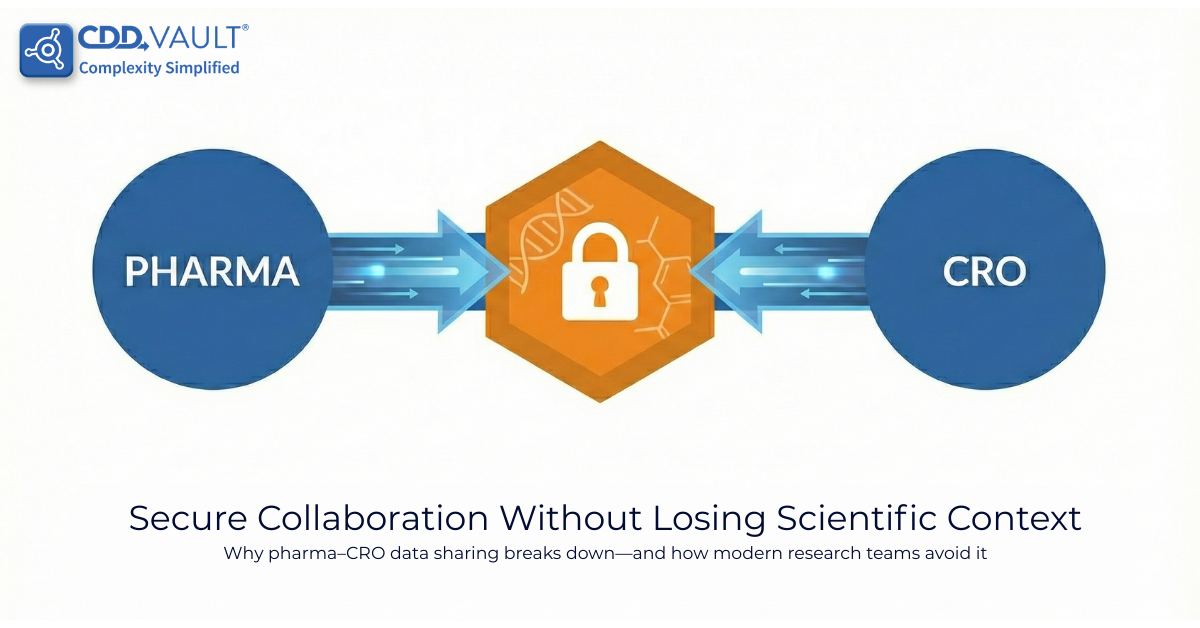
Why pharma–CRO data sharing breaks down—and how modern research teams avoid it
Pharma–CRO collaborations generate enormous volumes of experimental data. Yet over time, much of that data quietly loses its scientific value. The issue is rarely the quality of the experiments themselves. Instead, it stems from how data is shared, governed, and preserved once work crosses organizational boundaries.
CDD Vault is designed to address this structural problem at the data layer.
The Hidden Risk in Pharma–CRO Collaboration
Most collaboration models treat data as a deliverable. Results are packaged into files, transferred to sponsors, and stored as records of completed work. The scientific context behind those results—why experiments were designed a certain way, which approaches failed, and how decisions evolved—often lives elsewhere, scattered across emails, meetings, and individual memory.
While this approach may satisfy short-term contractual requirements, it introduces long-term risk. As programs advance, teams change, or decisions need to be revisited, critical context becomes difficult or impossible to reconstruct.
The result is a common but under-recognized failure mode: data is delivered, but it cannot be confidently reused.
Why Drug Discovery Data Doesn’t Disseminate Well
Drug discovery data is not modular or self-explanatory. Experimental results cannot be separated from the process that produced them. Their meaning depends on the surrounding scientific narrative—what was tried before, what assumptions were revised, and which paths were deliberately abandoned.
Modern R&D is iterative and cumulative. Data must remain interpretable months or years later, often by people who were not involved in the original experiments. Static handoffs such as spreadsheets, PDFs, and summary reports struggle in this environment. Once detached from context, data may appear complete while remaining scientifically ambiguous.
The False Tradeoff Between Sharing and Security
In many pharma–CRO collaborations, sponsors face a familiar tension. Sharing full experimental context can feel risky from an intellectual property and security perspective, while restricting access often means losing continuity and insight.
This creates a false tradeoff:
- share more data and risk losing control, or
- lock data down and accept long-term interpretability gaps
Neither option supports sustained, data-driven decision-making.
Effective collaboration requires an approach that allows external partners to contribute meaningfully without transferring ownership or weakening governance.
What Changes When Teams Share a Data Foundation
Long-running, successful collaborations tend to look different from the start. Instead of exchanging files, teams work within a shared, governed data environment where experimental results and context are captured together as work ensues.
In these environments:
- data is created directly inside a controlled system
- access is role-based and purpose-driven
- actions are traceable and auditable
- experimental context and decision history remain linked to results
When collaborations evolve or end, the accumulated scientific knowledge remains intact rather than fragmented across disconnected systems.
How CDD Vault Supports This Model of Collaboration
CDD Vault is built to support collaborative research while preserving long-term scientific continuity. Rather than treating data sharing and data security as competing goals, Vault treats them as interdependent system requirements.
By enabling CROs and external partners to work inside a controlled research environment, Vault helps organizations preserve experimental context, maintain governance, and retain institutional knowledge beyond individual projects or partnerships.
Why This Matters for Long-Term R&D Decisions
Failure is expected in drug discovery. What proves far more damaging is discovering—at a critical decision point—that years of data cannot be confidently reexamined or reused.
As R&D becomes increasingly distributed across organizations, geographies, and specialties, the ability to preserve scientific context and decision history becomes essential. Without it, organizations risk repeating work, misinterpreting results, or losing confidence in their own data.
A Question Worth Asking
How much of the data generated today would you trust to guide decisions two years from now—after teams change and priorities shift?
The future of collaborative drug discovery will be shaped not only by who conducts the science, but by how scientific knowledge is captured, governed, and sustained over time.