
September 10, 2025
CDD Vault now supports the Boltz-2 model, a next-generation machine learning algorithm designed for robust and generalizable predictions across complex, high-dimensional drug discovery datasets. This release represents a leap forward in CDD Vault’s advanced, yet accessible (“Complexity Simplified”), AI tools for collaborative research.
Protocol readout definitions allow users to utilize Boltz-2 protein folding and structure docking models directly on their data. The resulting prediction results and experimental data can be viewed directly side-by-side, to mathematically compare both methods.
To run your Boltz-2 model, create a protocol readout definition using the data type ‘Boltz-2’. To run protein folding and docking models, simply insert the protein sequence in FASTA format. Upload a CIF (Crystallographic Information File) if available to run a docking only model.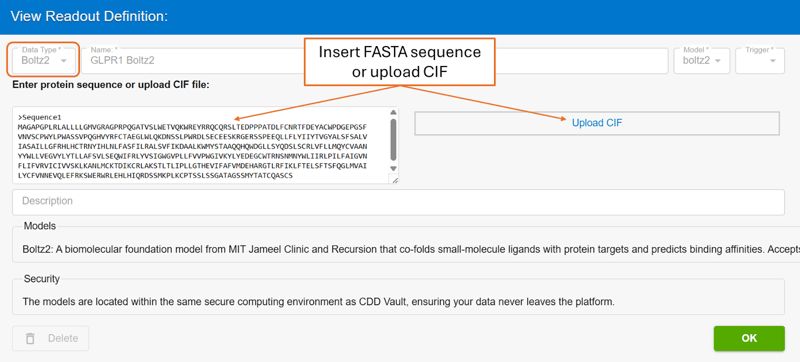
After running the model on a set of molecules, results are reported in a search report table as seen below. Molecules docked may be viewed either in predictively folded proteins or with the uploaded, experimentally determined protein crystal structure. Job status information is reported as a readout along with Affinity Prediction Values and Probability Binaries. 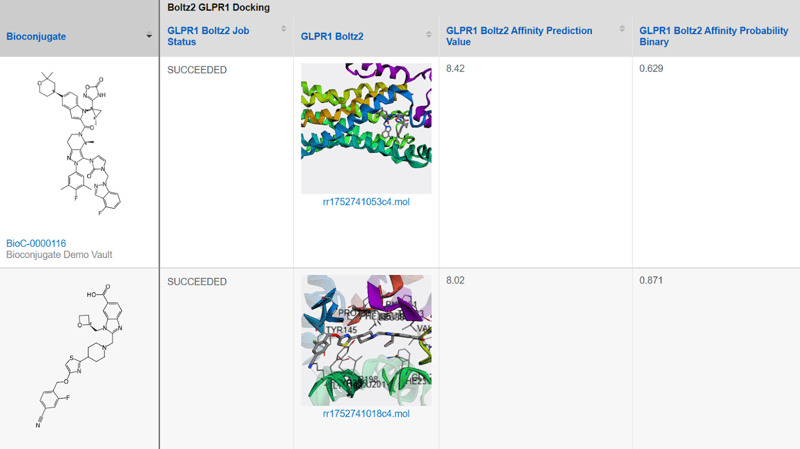
The Boltz-2 model is accessed via the AI+ add-on. Please contact support@collaborativedrug.com or your CDD Vault account manager to enable this feature.
To provide feedback on features, or if you have questions and want to schedule a demo, please contact support@collaborativedrug.com.