


May 5, 2026
“I am building a platform that would generate real-world TB bacteria responses to treatment, thereby derisking expensive clinical trials.” Dr. Leopold Tientcheu
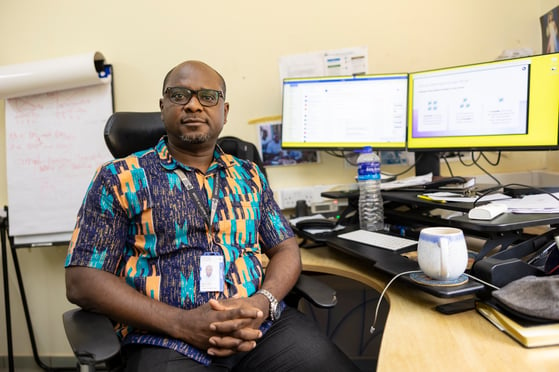
Dr. Leopold Tientcheu, Assistant Professor in Immunology
LinkedIn - LSHTM profile - ORCID profile
MRC Unit, The Gambia (MRCG) at London School of Hygiene & Tropical Medicine (LSHTM)
This February, at our annual European Life Science Community Meeting in Cambridge, UK, we sat down with Dr. Leopold Tientcheu to discuss his research on tuberculosis (TB), the challenges of managing complex biological datasets, and how CDD Vault has facilitated data analysis for him and his team. During our discussion, Dr. Tientcheu also highlighted the complexity of treating TB.
In the aftermath of the COVID-19 pandemic, TB has once again become the leading cause of human mortality from a single infectious agent. An estimated 10.7 million new TB cases and 1.23 million deaths occurred in 2024. Although treatments have been used for decades, the bacteria that cause TB are far from uniform. The “one-size-fits-all” TB treatment regimen fails to account for the vast diversity of bacterial strains circulating globally, leading to inconsistent patient outcomes.
The African continent hosts a wide diversity of Mycobacterium tuberculosis (TB) strains, reflecting both its long history with the disease and its varied human populations. Prominent lineages include the Euro-American (Lineage 4), East African–Indian (Lineage 3), and the Beijing lineage (Lineage 2), alongside region-specific strains such as Mycobacterium africanum (Lineages 5 and 6), which are largely restricted to West Africa, where Dr. Tientcheu focuses his research. This genetic diversity can influence transmission patterns, disease severity, and response to treatment, making TB control more complex and challenging.
For Dr. Leopold Tientcheu, Assistant Professor in Immunology at the MRC Unit, The Gambia (MRCG) at London School of Hygiene & Tropical Medicine (LSHTM), understanding that diversity is central to his research. His work focuses on studying clinical TB strains and analyzing how they respond to drugs, with the goal of improving treatment strategies.
We spoke with Dr. Tientcheu about his research, the challenges of managing complex biological datasets, and how his lab uses CDD Vault to analyze dose–response data.
What scientific question drives your research?
“My research, initiated 10-20 years ago, was designed to examine how people infected with different TB strains respond when they receive the same treatment.”
Tuberculosis is caused by a group of related bacteria known as the Mycobacterium tuberculosis complex, but those bacteria are genetically diverse.
“Tuberculosis is caused by this group of bacteria that are very diverse. Some are found mainly in West Africa, some in Asia, some in Europe, and some everywhere. But we still use exactly the same treatment for all these diverse bacteria.”
To better understand how strain diversity affects treatment outcomes, Dr. Tientcheu has spent years collecting and studying clinical TB isolates. At the MRCG@LSHTM, he leverages access to a collection of over 25,000 TB isolates from endemic settings, including over 2000 with whole-genome sequence data.
By studying bacteria isolated directly from patients, his research aims to capture biological differences that may not be apparent when using standard laboratory strains. “Why not learn from the bacteria that are actually in the clinic to better optimize the treatment regimen?”
How do you study drug responses across different strains?
A key part of Dr. Tientcheu’s work involves measuring how individual TB strains respond to drugs. “One of the things that I do is take each of these bacteria and determine the IC50 of each drug that we use to treat TB.”
In these experiments, bacteria are exposed to different drug concentrations and monitored over time. “I set up an assay where I put the bacteria in contact with the drug and observe whether the bacteria grow or not over 20 days.”
The resulting dose–response curves allow his team to calculate drug potency across strains. “I’m particularly interested in the IC50.”
These results allow Dr. Tientcheu’s team to build an advanced screening assay platform to evaluate both drug-resistant and drug-susceptible Mycobacterium tuberculosis strains. The platform enables rapid assessment of how different strains respond to therapeutic compounds, significantly accelerating the detection of tolerance patterns. By reducing the time required to obtain results to just 5 to 10 days, compared to traditional methods that can take weeks, these assays improve decision-making in the development of treatment strategies, which, in the long run, will support more effective treatment for tuberculosis.
Because TB therapy relies on multiple drugs used together, the next challenge is understanding how drugs work in combination.
“TB cannot be treated with only one drug, so patients are treated with multiple drugs. The big question is: What combination of drugs should be used to kill the bacteria by day 2 or day 5?”
“The data I generate help select the best combination and drug doses that are efficacious against many TB strains, improving their prospects for global use.”
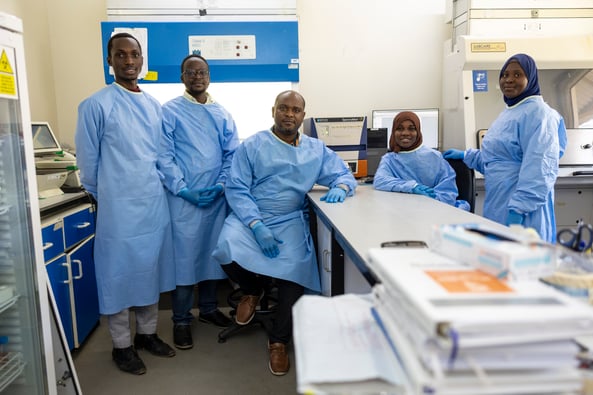
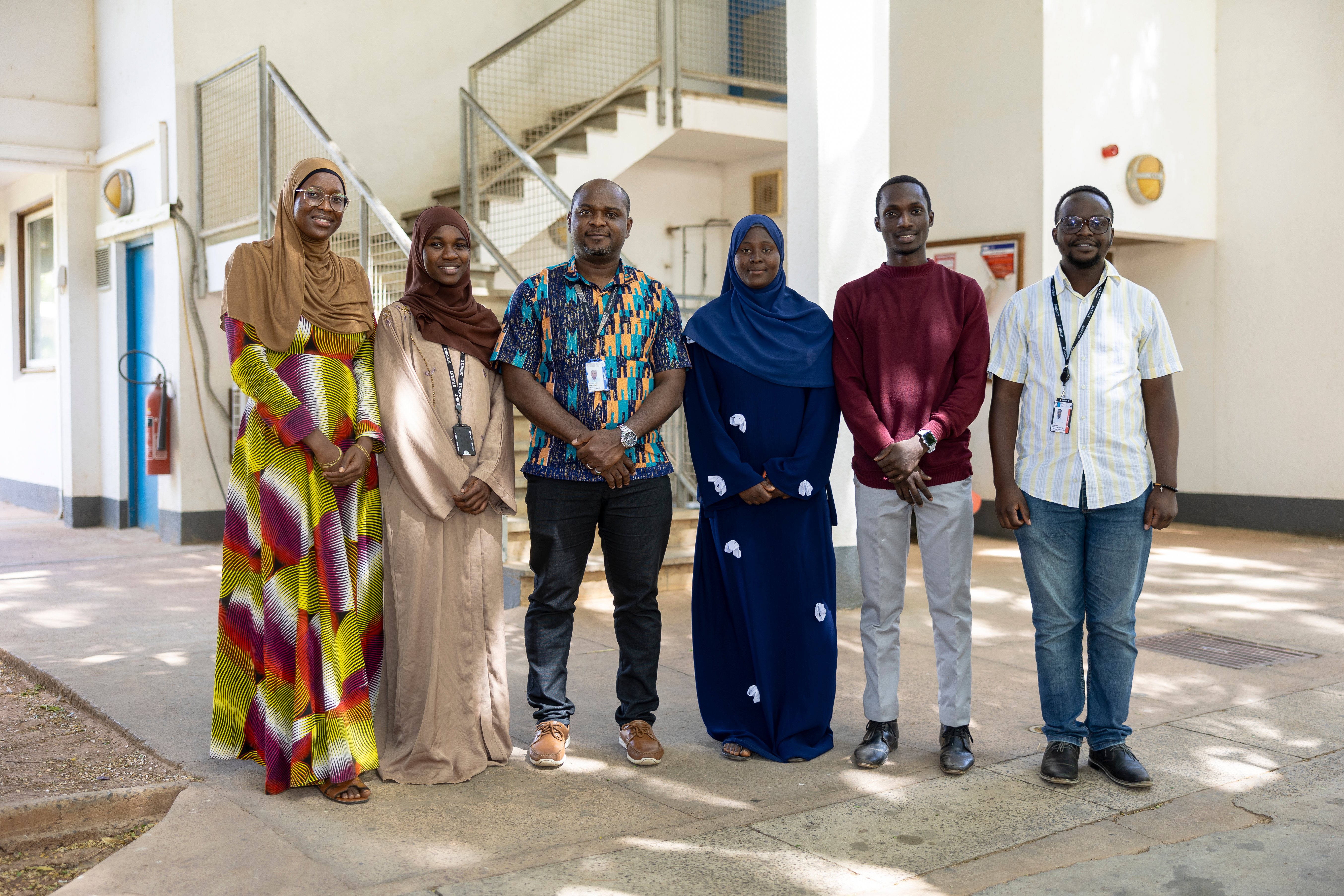
The Mycobacteriology and Immunology Research Team (MIRT). From left to right: Muhammed Nyang (MSc, Gambia), Dr. Kein Kalume (MD, DR Congo), Dr. Leopold Tientcheu (Assistant Professor, Team Leader, Cameroon), Fatou Faal (PhD student, Gambia), and Dobally Touray (BSc, Gambia)
How does CDD Vault help your lab manage and analyze data?
Dr. Tientcheu began using CDD Vault in March 2023 through an initiative that provided free access to researchers in Africa.
“I was one of the first to use the Vault when it was opened for Africans. I got on it because I was struggling with the data.”
Today, CDD Vault provides a centralized platform for organizing experimental results and analyzing dose–response curves.
“You generate the data, organize it in the right format, put it into the platform, then you get curves that you can analyze to determine the IC50 and move on with it.”
For his lab, the platform “has really streamlined all the processes we go through when analyzing data.”
Looking ahead
As his research continues to grow, Dr. Tientcheu is interested in further integrating automation and advanced analytics into his workflow. One possibility is connecting laboratory instruments directly to analysis platforms.
He also sees opportunities for AI-driven approaches to help interpret complex drug-response data.
“I am building a platform that would generate real-world TB bacteria responses to treatment, thereby derisking expensive clinical trials.”
As researchers like Dr. Tientcheu continue exploring the diversity of TB bacteria and their responses to treatment, tools that help organize and analyze complex datasets will remain essential for turning experimental data into actionable insights.
This blog is authored by members of the CDD Vault community. CDD Vault is a hosted drug discovery informatics platform that securely manages both private and external biological and chemical data. It provides core functionality including chemical registration, structure activity relationship, chemical inventory, and electronic lab notebook capabilities!
CDD Vault: Drug Discovery Informatics your whole project team will embrace!