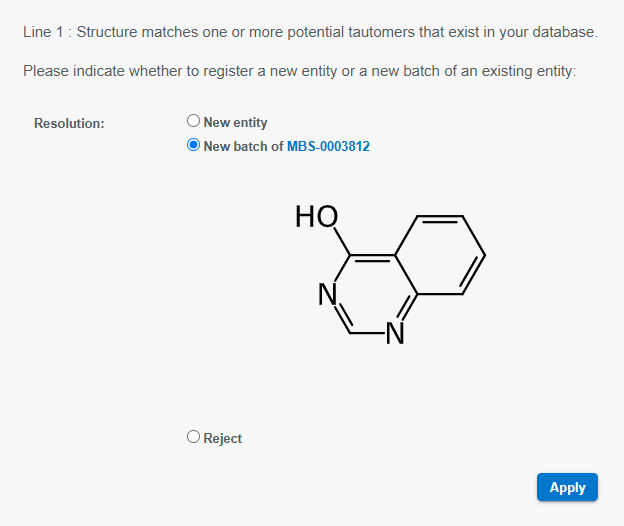
Registration that thinks like a chemist.
Every structure registered accurately and every duplicate caught.
- Every compound registered once. Salts and solvents stripped, structures standardized, and duplicates caught across every project and within each upload.
- Stereochemistry as intended. V3000 enhanced stereo AND/OR labels register racemates, unknown pure enantiomers, and known enantiomers as separate molecules.
- Atropisomers as distinct compounds. Axial chirality and other non‑tetrahedral cases are supported.
- Tautomers flagged. When a possible tautomer is detected, the chemist decides: new batch, new molecule, or duplicate.
- Register whole libraries in one import. Map data to custom fields, review a row‑by‑row QC report, and get IDs and properties generated automatically.
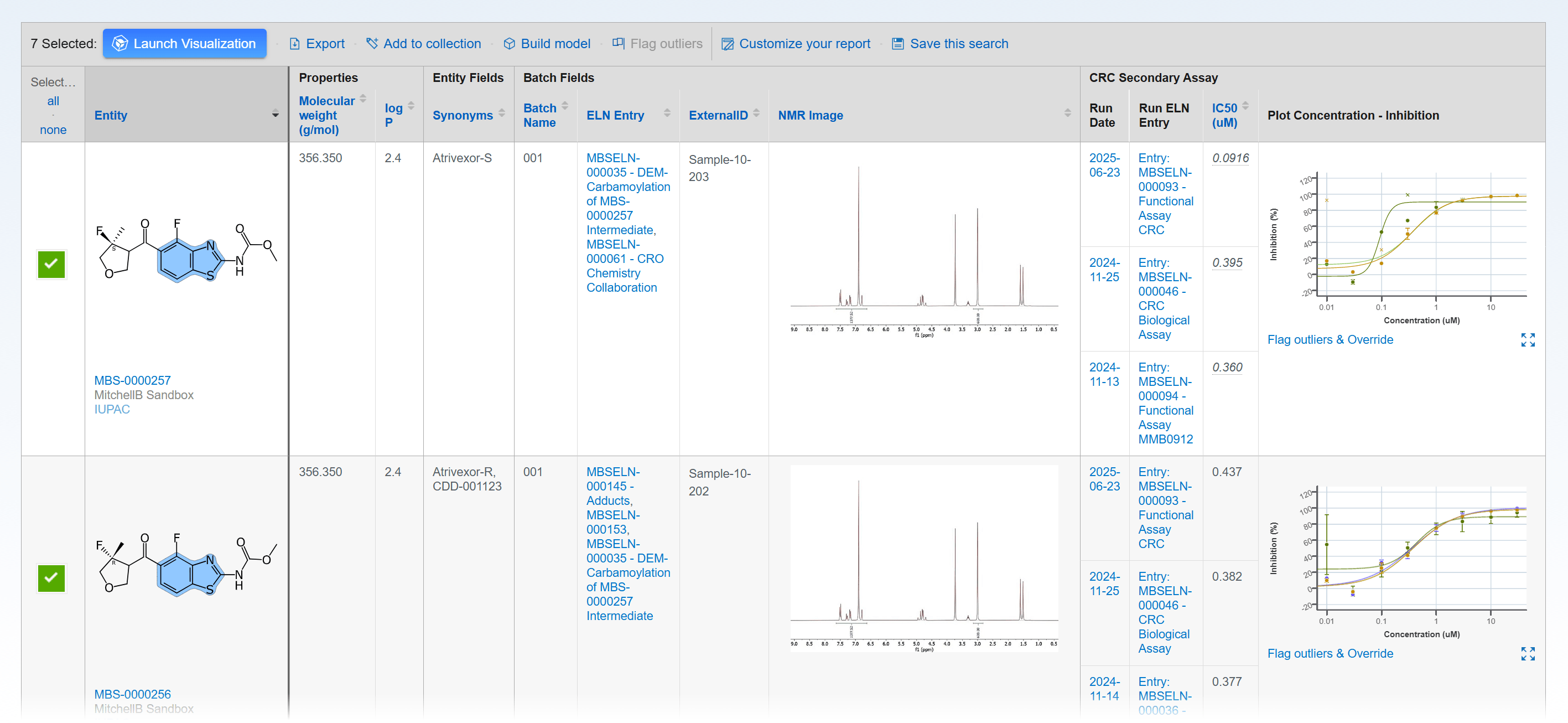
Every result connected to the batch that produced it.
The single source of truth from plate matrix data to endpoint values.
- Create AI-ready datasets. Standardize data structure across computational, in vitro, and in vivo studies.
- Rapidly identify hits. Intuitive search interface and customizable dashboards for high throughput analysis.
- Advanced data analysis. Automate data processing, QC workflows, curve fitting, and custom calculations including IC50, MIC, Ki/Kd, Z/Z', PK/PD, and ADMET.
- Ensure reproducibility and interoperability. Customizable assay annotation fields and built-in ontology templates provide context for AI/ML workflows.
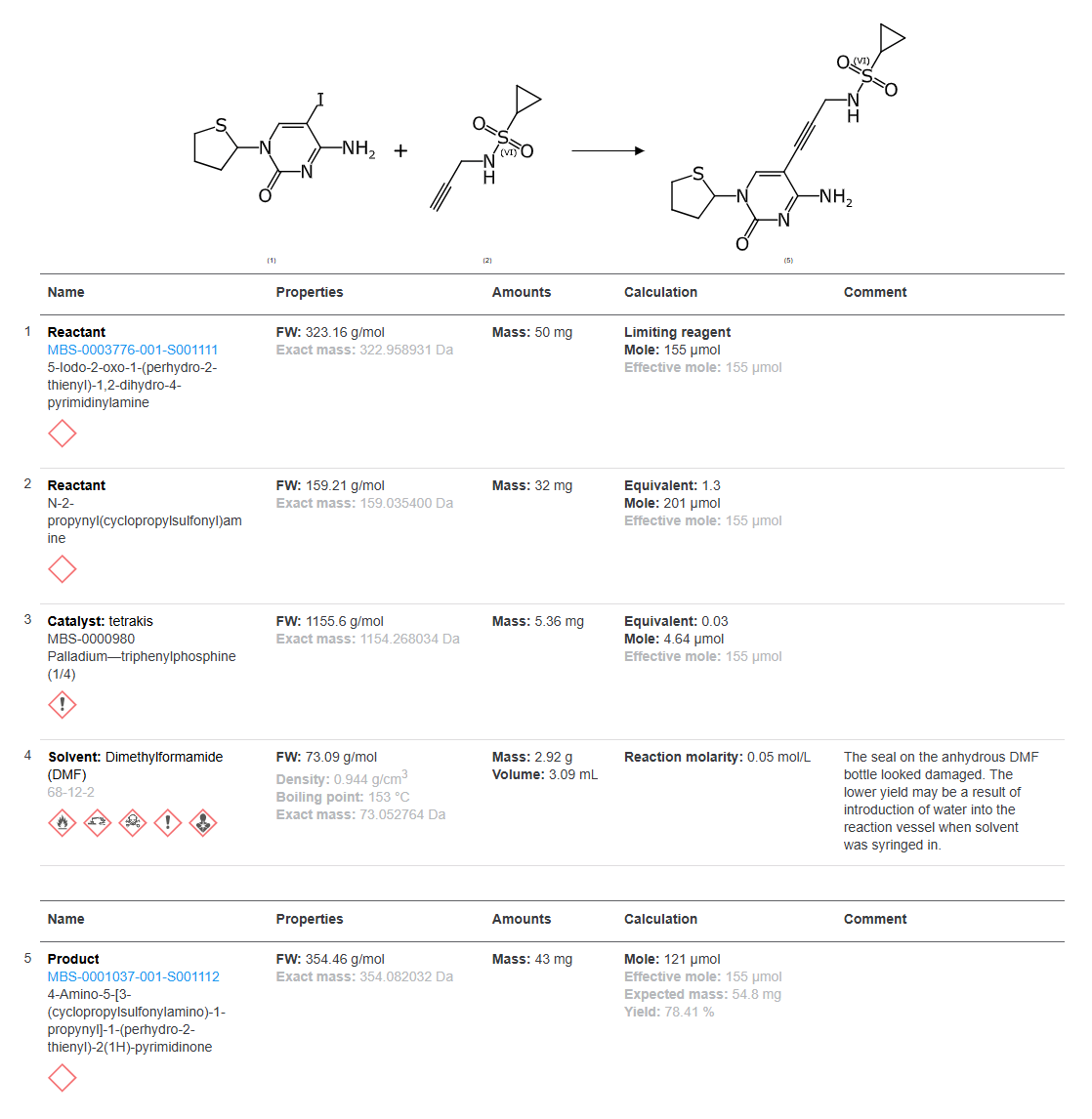
From reaction to registered compound in one interface.
Your electronic lab notebook, compound registry, and inventory stay in sync automatically.
- Register from the stoichiometry table. Draw or import a reaction, then register products and reagents from the entry.
- Automated stoichiometry calculations. Enter mass, moles, volume or density, and yield and expected mass update in real time.
- Every batch and sample links to its experiment. ELN links are added to each record automatically.
- Reagent stock debits from the ELN. Log what you used and your inventory updates.
- Every sample located. Nested locations from building to freezer, rack and box, with printable barcodes.
See the patterns in your data instantly.
Interactive plots and SAR tools built by chemists, for chemists.
- R‑group decomposition. Pick a suggested core or draw your own, and plot R1 and R2 against any other experimental parameter.
- Clustering and SuperSAR. Group molecules by Tanimoto similarity and filter by suggested SAR fragments.
- A data table built for SAR. Color‑coded columns, on‑the‑fly calculations, custom MPO scores, and one‑click pivots.
- 2D and 3D plots. Generate multiparameter publication quality graphics through an intuitive interface.
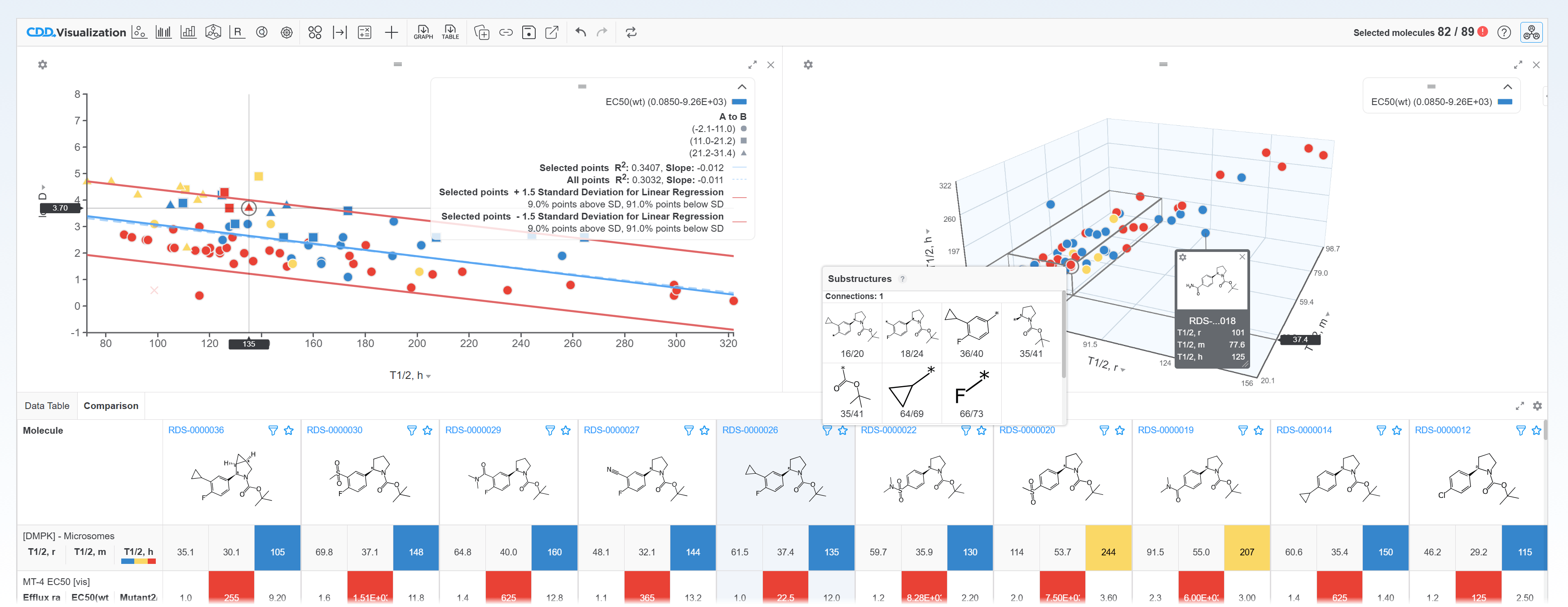
Explore new chemistry without exposing yours.
Generate virtual analogs, predict properties and activity, and check novelty securely in your CDD Vault.
- Bioisostere suggestions. Explore new hypotheses by iteratively generating synthetically accessible compounds.
- Predict ADMET before you synthesize. Use Lilly TuneLab to predict small-molecule ADMET properties across 33 common endpoints.
-
QSAR grounded in your own results. AI models build and retrain themselves from your assay data with nothing to configure and nothing to maintain.
- Similarity search beyond your Vault. Search 41.2 million structures from ChEMBL, SureChEMBL, CDD Public, Enamine, and Enamine RealDiversity.
-
Fold and dock without sending structures anywhere.
Run Boltz2, AlphaFold2, ESMFold, and DiffDock on CDD’s managed infrastructure, with results stored beside your assay data.
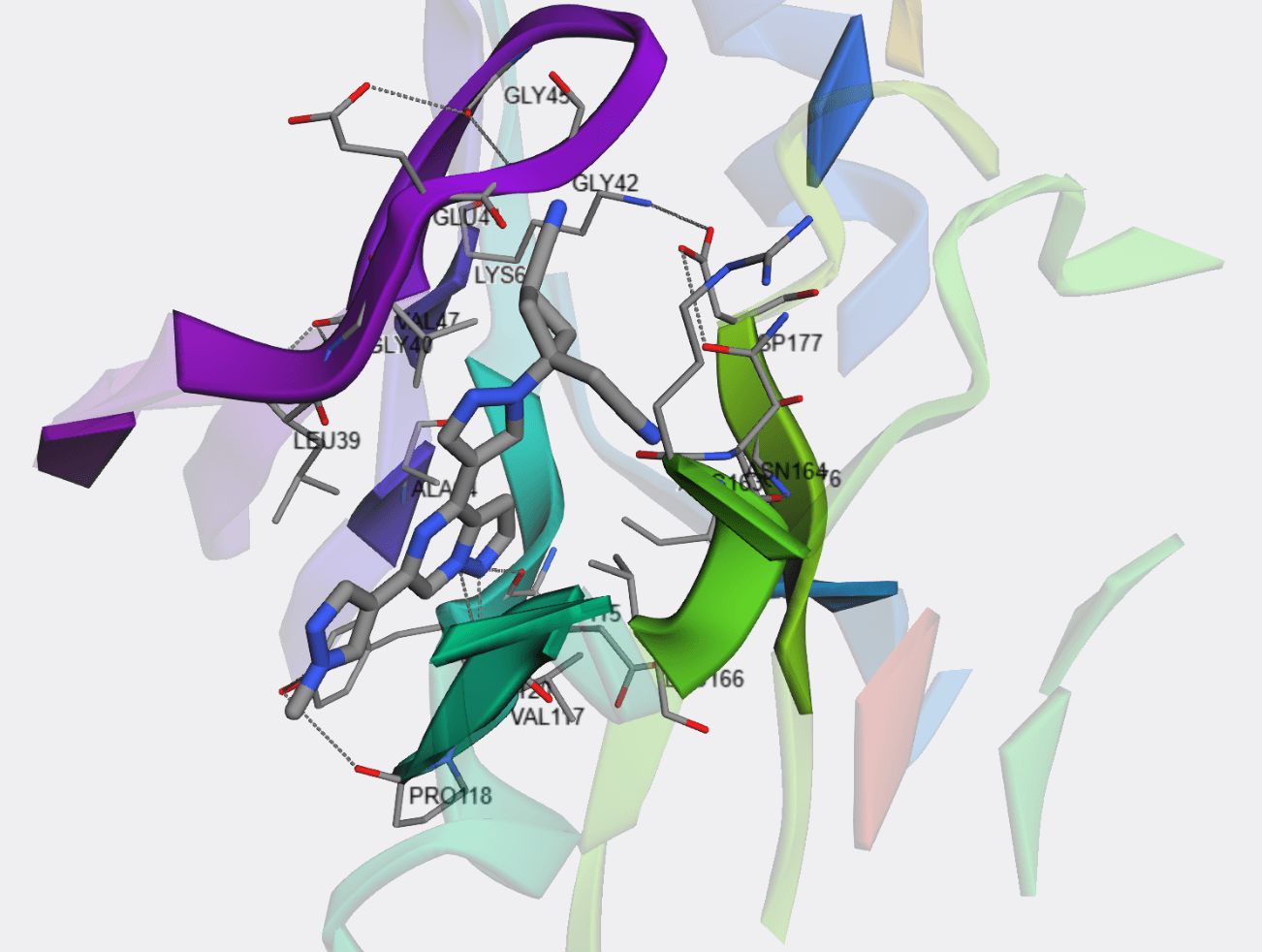
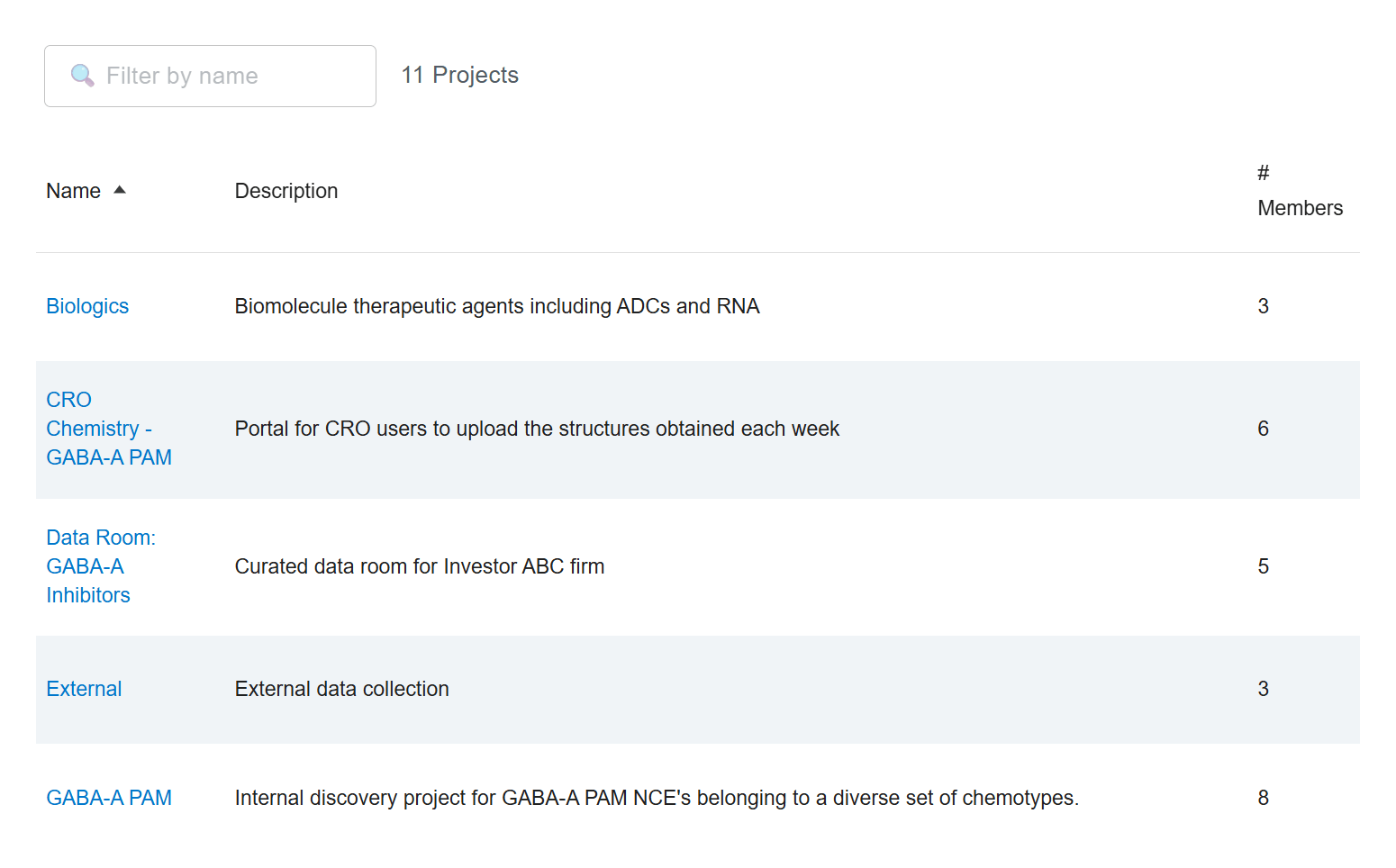
Collaboration that doesn’t cost you your IP.
Outsource synthesis and screening without handing over your library. Partners work in one firewalled project; your team gets every result in one place.
-
Partners deliver AI-ready data instead of spreadsheets. CROs register compounds and upload results directly into your Vault, so nothing arrives as an email attachment or a slide deck.
-
Project-level permissions.
Access is granted one project at a time. A CRO working on a single series never sees the rest of your library.
-
Your team works across all data. External results sit beside your own data for SAR, analysis, and project tracking the moment they land.
- Know where every external result came from. Audit trails record who registered or changed each record, so a CRO’s data is traceable years later.