

Situation
Scaffold Therapeutics is developing oral therapies for ALS, a fatal disease with no cure. The biology behind its approach also points the way to other diseases driven by a central protein, TDP‑43.
Amyotrophic Lateral Sclerosis (ALS), or Lou Gehrig's disease, progressively destroys the nerve cells that tell muscles how to move. It typically begins as weakness in the hands, feet, arms, or legs and advances until patients can no longer chew, swallow, speak, or breathe. Respiratory failure is the most common cause of death, on average within three to five years of symptom onset. In more than 97% of those patients, TDP‑43 is not properly regulated. The company’s molecules can be taken orally and cross into the brain and spinal cord, a challenge that has ended numerous drug discovery programs before they reach patients. Preclinical studies have demonstrated that our compounds cross the blood-brain barrier and are safe.
Solution
Scaffold Therapeutics deployed Collaborative Drug Discovery’s CDD Vault, the hosted drug discovery informatics platform that securely manages both internal and external biological and chemical data.
Scaffold uses CDD Vault as its central repository for several thousand molecules. The data are used by the company’s biologists and chemists. CROs working with Scaffold transmit their data via the CDD Vault ELN.
Benefits
Scaffold Therapeutics has enjoyed a number of benefits through use of CDD Vault, including:
- An “absolutely critical” central repository allows easy access to all data without requiring users to navigate multiple systems.
- Powerful searchability
- CROs use CDD Vault to register compounds and document reactions and capture assay results.
- CDD Vault protects IP and makes it possible to share data with investors.
- CDD Vault's ease of use and flexibility save time and money
|
|
CDD Vault's Ease of Use and Flexibility Serve as the Central Repository “It’s Absolutely Critical”
Scaffold Therapeutics values CDD Vault’s role as its central repository for all research done across its thousands of small molecules.
“We've been using CDD since the company’s inception,” says Jeff Carter, CEO & Founder of Scaffold Therapeutics. “With CDD Vault, everything is in there. You don't have to worry about finding things or losing data. Everything is in one place, which is a huge benefit.”
“It's absolutely critical,” says Neil J. Hayward, Chief Scientific Officer at Scaffold Therapeutics. “So much work goes into our efforts, and early on our scientists need a view into everything. It’s essential to have a database system where you're able to very quickly incorporate primary screen assays, secondary screen assays, and be able to start picking what you think is the development candidate and have the data to ensure everybody's on board.”
Powerful Searchability “Lets Us Drill Down to the Raw Data”
The robust and flexible searchability of CDD Vault is appreciated by Scaffold Therapeutics.
“We can search by assay, search by structure, search by ranges of results, by program, by target,” Carter says. “The searchability of CDD Vault is robust and flexible. We’ve never not been able to search for what we needed to see. For example, we can view the IC50 for a compound, and then link to the primary screen assay to see the key parameters and see where the raw data is coming from.”
CROs Use CDD Vault ELN to Transfer and Register Compounds
CROs working with Scaffold Therapeutics use their own CDD Vault ELNs to transfer and register compounds into a sandbox area of Scaffold’s CDD Vault. From there it is reviewed and loaded into Scaffold’s full CDD Vault central repository.
|
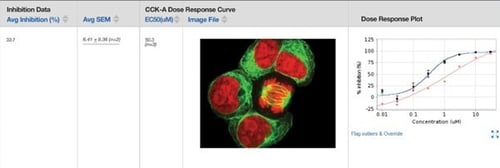
CDD Vault dose-response curve. |
“With CDD Vault receiving all of the data, we don’t have to return to the CRO with questions, because all of the assay data is right there for us to drill into and study,” Carter says. “All of our CROs already use CDD Vault and the ELN, so it makes data transfer very easy.”
CDD Vault Protects IP
In drug discovery, protecting IP is absolutely essential. Scaffold Therapeutics values the fact that CDD Vault is trusted throughout the industry as a secure repository to safeguard IP.
|
|
The granular security of CDD Vault protects IP from beginning to end.
“We have our CDD Vault permission-based controls set up so that when we’re using multiple CROs they can't see each other's work,” Carter says. “Throughout our operations, the granular security of CDD Vault helps protect our IP.”
When the time comes to license or sell discoveries, Carter says CDD Vault serves to ensure IP integrity, as well as to find the right data to populate a data room.
CDD Vault “Makes the Data More Digestible”
Scaffold Therapeutics values CDD Vault for its ability to fit, analyze, and overlay data from multiple compounds, experiments, and assays to track SAR.
“CDD Vault makes the data more digestible,” says Carter. “It gives you the ability to remove outlier points, and provides analysis beyond what just looking at numbers can do. And we like that it embeds the curve images into the reports.”
“Curves visualization is critically important because when you see an IC50, you want to know what the max is as well,” says Hayward. “It could be a partial agonist, it could be a partial antagonist, and I want to see if it gets to 100% because an IC50 is 50. If I don't have the graph, it could be pretty flat, it might only get to 52 and C max could be critical in terms of potential efficacy. I used to work on partial kappa opiate agonists, and for goodness sake, we never wanted anybody above a 75% inhibition, for obvious reasons. So, the visual aspect is extremely important.”
Ease of Use and Flexibility of CDD Vault Saves Time and Money “It’s Become an Industry Standard for Early-Stage Biotech”
Cloud-based CDD Vault is so easy to administer and use that it saves Scaffold Therapeutics time and money.
“CDD Vault saves us money because I don't have to hire software engineers and create my own infrastructure,” Carter says. “It also saves me time and money, because I can manage all the configuration myself. We don’t need to hire an informatics administrator.”
“As our central repository, CDD Vault saves all of us time because everybody knows exactly where to find things,” Carter continues. “The central repository also eases compliance burden.”
Hayward likes the flexibility and configurability of CDD Vault, which makes it easy to add additional columns for statements and observations. Hayward says, “As we get further along, it won't just be numbers anymore, it's going to be observations and statements that are going to drive our decision making.”
“CDD Vault is so flexible and easy to work with it’s become an industry standard for early-stage biotech,” Carter says.
