
August 27, 2026
How PharmTheon Combines Scientific Excellence, Digital Innovation and CDD’s Collaborative Technology to Accelerate Drug Discovery
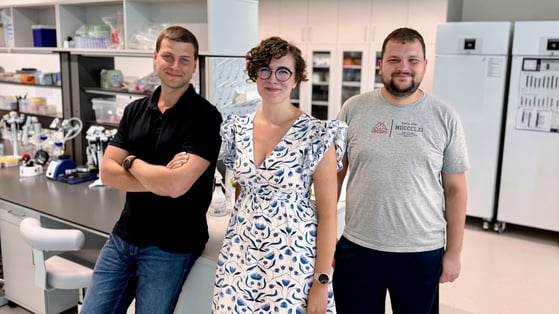
Every company has an origin story. PharmTheon's begins with three people who took very different paths into science, yet all arrived at the same destination: translating research into medicines.
For CEO Jan Skácel, the journey began unexpectedly. As a child, he dreamed of becoming an archaeologist. That ambition changed abruptly in sixth grade when he realized that remembering dates and historical names simply wasn't his strength. Chemistry, however, offered something different: a discipline built on solving problems rather than memorising facts. From that moment, he set himself a remarkably clear goal: to develop medicines.
That determination shaped every step of his career, from studying chemistry at the University of Chemistry and Technology in Prague, to completing his PhD at the Institute of Organic Chemistry and Biochemistry (IOCB Prague), followed by postdoctoral research at Johns Hopkins University. While an academic career was an obvious path, Jan found himself increasingly drawn to applied science, the challenge of ensuring discoveries left the laboratory and reached patients.
His colleagues followed equally distinctive journeys.
Dr. Katarina Pšenáková, PharmTheon's Head of Biology, describes herself first and foremost as a structural biologist. After completing her PhD in Prague, she spent almost six years at Harvard University working alongside world-leading scientists before returning to the Czech Republic. Today, she jokes that she is still fortunate enough to work "with the most amazing scientists in the world", only now, they are building medicines together.
Completing the trio is Matuš Drexler, whose unusual combination of analytical chemistry and information technology has made him indispensable at PharmTeon and IOCB Prague. He bridges two traditionally separate disciplines: experimental science and scientific informatics. His expertise and deep knowledge of CDD Vault have become central to how the company captures, organizes, and extracts value from its scientific knowledge.
Together, their backgrounds perfectly illustrate PharmTheon's philosophy. Successful drug discovery is no longer the domain of chemists or biologists working in isolation. It requires multidisciplinary teams capable of integrating chemistry, biology, computation and data science into a single research engine.
Building a Different Kind of Drug Discovery Company
Many organizations describe themselves as translational research companies. PharmTheon prefers to demonstrate what that actually means.
Born from IOCB Prague's long history of scientific excellence and technology transfer, the company was created to solve a problem that Jan and his colleagues had witnessed repeatedly throughout their academic careers. Exceptional scientific discoveries were being made. Many were published in prestigious journals. Yet only a tiny fraction ever progressed towards becoming medicines.
"The reality," Jan explains, "is that today's academic researchers already carry enormous responsibilities. They are expected to conduct outstanding science, secure funding, supervise students, publish papers and teach. Translating discoveries into therapies requires another entirely different set of expertise."
Rather than expecting individual researchers to become entrepreneurs, medicinal chemists, project managers and regulatory specialists simultaneously, PharmTheon assembled those capabilities into one dedicated organization.
Its role is not simply to perform experiments. Instead, the company evaluates promising discoveries, validates biological hypotheses, designs drug discovery strategies, generates lead compounds and de-risks programs until they become attractive for pharmaceutical companies or investors capable of taking them into clinical development.
This distinction is fundamental. PharmTheon is deeply invested in the scientific success of every program it supports. It contributes intellectual leadership, strategic thinking and frequently its own financial resources during the earliest—and riskiest—stages of development.
As Katarina explains, many organizations can execute experiments. Far fewer can transform early academic discoveries into credible therapeutic opportunities.
That capability has become PharmTheon's defining mission.
A combination of Technology and People
Drug discovery is often described through the lens of technologies: artificial intelligence, data management, robotics, automation, high-throughput screening and computational chemistry.
Ask the PharmTheon team what makes the organization successful, however, and they highlight: People.
For Jan, building multidisciplinary teams begins with personality. Scientific excellence is essential, but it is not enough. Researchers from very different backgrounds must be able to communicate openly, challenge one another and remain focused on solving shared problems.
Katarina expands on this idea by highlighting one of the less visible challenges of translational research.
Academic scientists, industrial researchers, computational biologists and medicinal chemists often approach problems using entirely different language, priorities and expectations. Creating genuine collaboration requires creating an environment where specialists understand each other's perspectives.
As she puts it, the secret lies in ensuring that people with different expertise learn how to speak the same scientific language.
This collaborative mindset permeates every aspect of PharmTheon. Rather than operating as separate chemistry, biology or informatics departments, projects evolve through continuous dialogue across disciplines, a culture that reflects the complexity of modern drug discovery itself.
Closing the Gap Between Discovery and Patients
Perhaps the strongest message to emerge from the conversation concerns what happens to scientific discoveries after publication.
For every breakthrough that eventually becomes a medicine, countless others quietly disappear into the scientific literature.
Katarina believes this represents one of the greatest inefficiencies in biomedical research. Outstanding ideas are published, cited and admired, but never translated into therapies capable of helping patients.
PharmTheon was created to change that.
The company actively searches for discoveries with genuine therapeutic potential, particularly in areas of high unmet medical need such as oncology and metabolic diseases.
Rather than waiting until projects have already matured, the team engages early, working alongside academic scientists to generate the evidence required for commercial development.
That often means validating biological mechanisms, designing medicinal chemistry strategies, producing tool compounds and reducing scientific risk long before pharmaceutical companies become involved.
Clinical development remains the domain of larger pharmaceutical partners, but PharmTheon's role is to bridge the dangerous gap that exists between basic research and commercial investment.
It is this ability to transform promising science into investable programs that distinguishes the company.
For PharmTheon, success is measured not simply by publications or patents, but ultimately by patients who benefit from therapies that might otherwise never have existed.
CDD Vault: FAIR Data as a Competitive Advantage
Modern drug discovery generates enormous volumes of information—from chemical structures and reactions to biological assays, protein and cell data, experimental protocols, and analytical measurements.
Without effective data management, much of that knowledge becomes fragmented across spreadsheets, laboratory notebooks and disconnected software platforms.
At PharmTheon, scientific data is treated as a strategic asset. At the center of this infrastructure sits CDD Vault, which serves as the company's primary scientific knowledge platform.
For Matuš Drexler, however, simply storing data is not enough. The real challenge is making data accessible, reusable and frictionless for scientists.
To achieve this, he has developed a growing ecosystem of internal applications that automate routine laboratory tasks, simplify synthetic chemistry planning, organize experimental files and streamline data management.
He has even created an open-source browser extension for CDD Vault that enhances scientists’ everyday workflow. Matuš sees these developments as an example of collaborative innovation.
Platforms should evolve alongside their users, and custom tools allow researchers to tailor interfaces around their own workflows while providing valuable feedback that can eventually improve the underlying platform itself.
Jan points out that these seemingly small interface improvements often have surprisingly large consequences.
Different scientists interact with the same information in different ways. The extensibility of CDD Vault and the ability to add functionality by Matuš increases efficiency, improves adoption and ultimately allows researchers to focus more of their energy on science rather than administration.
AI Needs Better Data: Not More Hype
Artificial intelligence has become impossible to ignore in drug discovery. Yet PharmTheon's perspective is refreshingly pragmatic.
Jan believes AI has already demonstrated enormous value, particularly in molecular property prediction and computational modelling. Those advances are no longer speculative; they have become part of everyday medicinal chemistry.
The real bottleneck lies elsewhere.
AI systems remain fundamentally dependent on the quality of the data used to train and validate them. Incomplete datasets, inconsistent annotations and poorly curated experimental results inevitably limit the performance of even the most sophisticated algorithms.
For PharmTheon, this reinforces the importance of robust scientific infrastructure.
Good data management is not administrative overhead. It is a prerequisite for meaningful artificial intelligence.
Matuš sees AI transforming another important aspect of scientific work: accessibility.
Tasks that previously required experienced software developers can increasingly be performed by scientists themselves through modern AI-assisted programming tools.
Rather than replacing researchers, AI is lowering technical barriers and allowing more scientists to analyze data, automate workflows and extract insights independently.
The future, they suggest, will not belong to organizations with the loudest AI marketing, but to those with the highest-quality scientific data.
Why Prague?
For decades, cities such as Boston, Cambridge and San Diego have dominated conversations about biotechnology. Prague rarely appears on those lists.
According to the PharmTheon team, perhaps it should.
The Czech Republic has quietly built one of Europe's most dynamic life science ecosystems, supported by internationally recognized academic institutions, successful technology transfer organizations and a growing network of biotechnology companies.
Katarina, having experienced both Harvard and Prague first-hand, believes the Czech ecosystem possesses a unique strength. Its size.
Rather than competing aggressively against one another, researchers, universities, technology transfer offices and biotechnology companies frequently collaborate.
Organizations such as Prague.bio actively encourage these connections, creating an unusually supportive environment for innovation.
Jan is quick to point out that this ecosystem did not emerge overnight. It represents more than fifteen years of sustained investment in technology transfer, entrepreneurship and scientific commercialization, particularly through the efforts of IOCB Tech.
Today, that long-term vision is beginning to attract international attention.
For PharmTheon, Prague is more than simply its location. It is an integral part of the company's identity.
Looking Ahead
Ask the team where they hope PharmTheon will be in five years, and their answers begin with the impact they want to make. They talk about patients.
Katarina hopes to see one of the company's programs successfully progressing through clinical development, a therapy capable of making a tangible difference to people's lives.
Jan shares that ambition but also hopes PharmTheon becomes internationally recognized as one of Europe's leading partners for translating scientific discovery into medicines.
Matuš, reflects on what success would really mean: seeing a project that began as an idea ultimately become something that genuinely improves human health.
Their answers reveal a common theme.
For PharmTheon, success is not defined by scientific publications, technological sophistication or financial growth alone. It is defined by the ability to move knowledge beyond the laboratory and ultimately, to ensure that exceptional science fulfils its greatest purpose, improving patients' lives.
As Jan summarizes in a phrase that captures the company's entire philosophy:
"We are translating knowledge."