

July 22, 2026
Choosing a research informatics platform for your mid-sized biotech team is no small task. You need a system that handles chemistry and biology data, supports secure collaboration with external partners, and integrates with your existing workflows without being a huge IT burden.
CDD Vault offers mid-sized biotech teams a hosted research informatics platform built specifically for drug discovery research. In this guide, you'll find a ranked comparison of the platforms that matter most for biotech data management, along with the criteria we used to evaluate them.
Quick guide: 6 research informatics platforms for mid-sized biotech teams
- CDD Vault: A leading choice for secure, collaborative drug discovery data management
- Benchling: A cloud-native option with molecular biology focus
- Sapio Sciences: LIMS-centered platform with sample management capabilities
- Dotmatics: Data analytics orientation with visualization tools
- LabGuru: Lab management platform with ELN functionality
- SciSpot: No-code platform for lab operations
How we chose research informatics platforms for mid-sized biotech
When you're running drug discovery programs with limited internal IT resources, your informatics platform needs to do more than store data. It has to unify chemistry and biology information, protect your intellectual property, and let your scientists collaborate securely. Whether they share the same wet lab space or they sit across the globe, successful teams produce the best science when they establish concrete data infrastructure to support their research.
We evaluated each platform against the criteria that matter most to mid-sized biotech research leaders:
- Data unification: Can you bring chemical structures, biological sequences, and assay results into a single, searchable database? This eliminates the arduous process of reconciling information scattered across fragmented systems. It serves as a system of record.
- Security and IP protection: Does the platform meet rigorous security standards, including SOC 2 Type II and 21 CFR Part 11 compliance through comprehensive audit trails and role-based access? Your collaborators and investors expect nothing less.
- External collaboration: Can you share specific data views with CRO partners without exposing your entire dataset? Mid-sized teams rely heavily on external collaborators.
- AI and ML readiness: Is your data structured in ways that support predictive modeling and machine learning applications? This is becoming essential for modern drug discovery.
- IT overhead: Does the platform operate as a fully hosted SaaS solution, or will it require dedicated infrastructure and specialized in-house expertise? Most mid-sized biotechs cannot support a large IT team, and staff turnover can leave internally managed systems difficult and costly to maintain.
- Onboarding speed: How quickly can your scientists start using the platform productively? Time spent on training is time not spent on science.
The 6 research informatics platforms for mid-sized biotech teams
1. CDD Vault: Best research informatics platform for mid-sized biotech
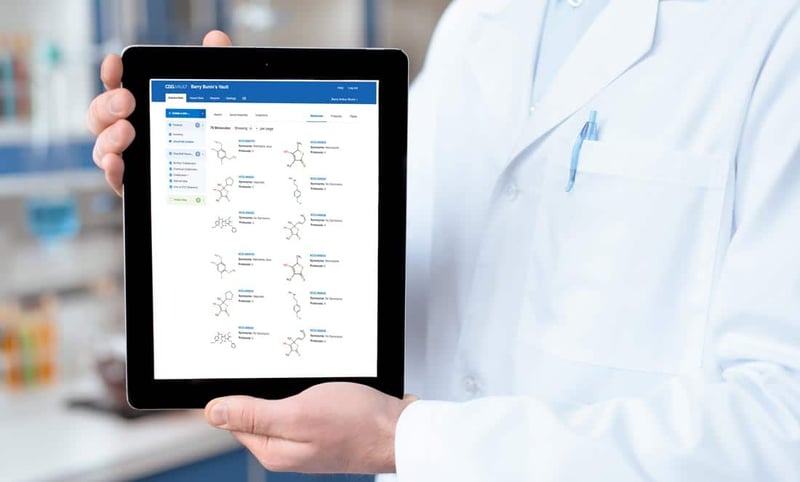
CDD Vault was recently recognized as the Scientific Data Management System of the Year 2026 and is a great choice for mid-sized biotech companies focused on drug discovery. The platform brings together chemical and biological registration, assay data, inventory, SAR analysis, and electronic lab notebook (ELN) functions in a single hosted environment.
What makes CDD Vault particularly valuable for mid-sized teams is its approach to collaboration. You can grant external partners, such as CRO teams or academic collaborators, access to specific projects while keeping the rest of your data private. This means your intellectual property stays protected even as you work with multiple external groups.
CDD Vault structures your experimental data in AI-ready formats from day one. When you're ready to build predictive models, your data is already organized for machine learning applications. The platform also includes built-in generative AI tools and automated inference models that help you identify promising compounds faster, and has partnered with Lilly TuneLab to make Lilly AI/ML models available within the system.
CDD Vault features
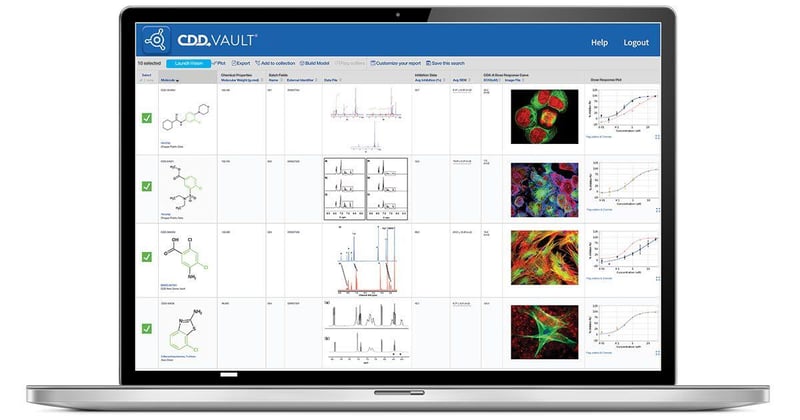
- Unified chemistry-biology registration: Register small molecules, biologics, and modified bioconjugates alongside assay data, giving you one source of truth for all your compound information.
- Secure external collaboration: Share specific data views with CRO partners while maintaining granular control over what each collaborator can see and access.
- AI-enabled discovery workflows: Accelerate molecular design, structure prediction, and scientific-decision making with AI capabilities built into CDD Vault. Access your CDD Vault through the Claude MCP connector. These features are available without separate AI infrastructure or custom data pipelines.
- SAR visualization: Generate multi-experiment overlays and dose-response curves that help you spot trends across compounds and targets.
- SOC 2 Type II compliance: Meet the security requirements your pharmaceutical partners expect, with full audit trails and role-based access controls.
- RESTful API integration: Connect CDD Vault to your existing instruments, ELN systems, and analysis tools through well-documented APIs.
 CDD Vault pros and cons
Pros:
- Lab-trained scientists and former CDD Vault customers staff the support team, so you receive answers from people who understand your workflows
- Fully hosted SaaS model means zero internal IT burden for maintenance and updates
- Professional help on data migration from other platforms, including ELN content, makes transition painless
Cons:
- Focused primarily on drug discovery workflows, so teams outside pharmaceutical research may find some features less relevant. This specialization is exactly what makes it valuable for biotech
- Advanced AI features run on consistent, well-organized data entry. Capturing it in a structured format from the start, which most manual processes do not do (but which most instruments do), may require a little upfront investment. It does ultimately unlock deeper analysis in the end when set up correctly from the start
- Maximum value comes from using multiple modules together, so teams wanting only basic registration may not need everything the platform offers
2. Benchling: Cloud-native platform with molecular biology focus
Benchling offers a cloud-based platform that emphasizes molecular biology workflows. The system includes sequence design tools and a notebook interface for documenting experiments.
The platform has gained adoption among teams working primarily with biological sequences. It includes CRISPR design features and plasmid mapping tools that support genetic engineering projects.
Benchling features
- Sequence design tools: Design and annotate DNA, RNA, and protein sequences with visualization features
- Electronic lab notebook: Document experiments with structured templates and embedded molecular data
- Registry system: Track biological entities with custom schemas and relationships
Benchling pros and cons
Pros:
- Includes molecular biology-specific tools for sequence design
- Cloud-based access from any browser
- Supports custom registry schemas
Cons:
- Chemistry registration and SAR analysis are less developed than biology features
- Collaboration controls may require additional configuration for complex partner arrangements
- Some advanced features require enterprise-tier access
3. Sapio Sciences: LIMS-centered platform with sample management
Sapio Sciences focuses on laboratory information management with attention to sample tracking and workflow automation. The platform originated in the LIMS space and has expanded to include ELN capabilities.
Teams with heavy sample management requirements may find Sapio's tracking features useful. The platform includes barcode scanning and chain-of-custody documentation.
Sapio Sciences features
- Sample tracking: Monitor samples through laboratory workflows with barcode integration
- Workflow automation: Configure automated processes for routine laboratory tasks
- ELN module: Document experiments with templates and structured data capture
Sapio Sciences pros and cons
Pros:
- Sample management and tracking features are well-developed
- Workflow automation reduces manual data entry
- Includes regulatory compliance features
Cons:
- Chemistry-specific features like SAR analysis are not the primary focus
- Integration with external collaborators requires additional setup
- Implementation timelines can vary based on customization needs
4. Dotmatics: Data analytics orientation with visualization
Dotmatics combines several acquired products into a platform focused on scientific data analytics. The system includes tools for data visualization and analysis across research workflows.
The platform has grown through acquisitions, bringing together capabilities from multiple legacy systems. This gives it broad feature coverage, though the user experience can vary between modules.
Dotmatics features
- Data visualization: Create charts and graphs from experimental data
- Browser-based access: Access data and tools through web interface
- Multi-domain data: Store chemical, biological, and analytical data
Dotmatics pros and cons
Pros:
- Offers analytics and visualization capabilities
- Covers multiple scientific domains
- Available as cloud deployment
Cons:
- Multiple acquired products can create inconsistent user experiences
- Full platform access may require multiple module licenses
- Configuration complexity increases with customization
5. LabGuru: Lab management platform with ELN functionality
LabGuru offers laboratory management features including electronic lab notebooks and inventory tracking. The platform targets academic and research institutions alongside commercial labs.
The system includes protocol management and equipment scheduling alongside data documentation features. It has found adoption in academic settings.
LabGuru features
- Electronic lab notebook: Document experiments with templates and attachments
- Inventory management: Track reagents, samples, and consumables
- Protocol library: Store and share standard operating procedures
LabGuru pros and cons
Pros:
- Combines ELN with inventory and protocol management
- Includes equipment scheduling features
- Supports academic research workflows
Cons:
- Drug discovery-specific features like SAR analysis are limited
- Chemical registration capabilities are basic compared to specialized platforms
- External collaboration features may not meet pharmaceutical partner requirements
6. SciSpot: No-code platform for lab operations
SciSpot markets itself as a no-code platform for laboratory operations, allowing teams to configure workflows without programming expertise. The system targets teams wanting customizable lab management.
The platform emphasizes flexibility, letting you build custom applications for tracking data and automating processes. This approach works for teams with specific operational needs.
SciSpot features
- No-code configuration: Build custom applications without programming
- Workflow automation: Automate routine laboratory processes
- Integrations: Connect with other laboratory tools and instruments
SciSpot pros and cons
Pros:
- Flexible configuration without coding
- Workflow automation capabilities
- Integration options with other tools
Cons:
- Scientific analysis features like dose-response curves are not built-in
- Chemical structure handling requires additional configuration
- Drug discovery-specific workflows need custom building
 Comparison table: Research informatics platforms for mid-sized biotech
| Platform | Chem + Bio Unified | Registration + query | Assay Data | Built-In SAR Analytics | CRO / Team Collaboration | AI / ML Readiness |
| CDD Vault | ✓ Compounds, batches, biologics / sequences | ✓ Chemical registration, validation, structure search | ✓ Protocols, dose-response, plate QC | ✓ SAR, R-groups, clustering | ✓ External teams / CRO workflows + access control | ✓ Structured data ready for modeling and downstream ML |
| Benchling | ◐ Biology-first | ◐ Basic chemistry | ◐ Basic analysis | ◐ Limited SAR | ✓ Enterprise collaboration / permissions | ✓ today given Benchling's expanding AI platform and APIs. |
| Sapio Sciences | ✓ Chemistry + biology platform | ✓ Sapio Chemistry registration + structure search | ✓ LIMS / ELN workflows with assay-result context | ◐ Limited SAR | ✓ Chemistry, screening lab, CRO collaboration | ◐ Expanding AI |
| Dotmatics | ✓ Chemistry + biology informatics | ✓ Bio / chem entity registration | ✓ Data intelligence / instrument data | ✓ SAR, R-groups, matched pairs | ✓ Shareable workspaces | ◐ Luma-based |
| LabGuru | ◐ ELN-focused | ◐ Basic inventory | ◐ Basic analysis | ✗ No SAR | ✓ Lab collaboration | ◐ Assistant-based |
| SciSpot | ◐ Workflow-centric | ◐ Configurable setup | ◐ Custom workflows | ✗ No SAR | ✓ Connected lab collaboration | ◐ Workflow AI |
What should mid-sized biotech teams look for in research informatics platforms?
Mid-sized biotech companies face a specific set of challenges that differ from both startups and large pharma. You have enough data and complexity to need a real informatics system, but you likely don't have a dedicated IT team to maintain on-premises infrastructure.
The most important consideration is whether the platform can grow with you. As your drug discovery programs advance, you'll generate more data, add more collaborators, and need more sophisticated analysis tools. CDD Vault addresses this by offering a modular architecture that lets you start with core registration and add capabilities like AI-powered predictive models as your needs evolve.
Security is equally critical. When you're working with CROs, academic partners, or potential pharma partners, they'll expect your data management to meet pharmaceutical-grade standards. Look for SOC 2 Type II certification and granular access controls that let you share exactly what each partner needs and nothing beyond..
How does AI integration benefit drug discovery data management?
AI and machine learning applications are reshaping how biotech teams analyze their data, but these tools are only as good as the data feeding them. A research informatics platform that structures your data correctly from the start makes the difference between models that work and models that don't.
CDD Vault approaches this by building AI-ready data structures into the registration process. When you register a compound, the platform captures it in formats that machine learning algorithms can immediately use. You don't need to export, reformat, and clean your data before running predictions.
The platform also includes zero-click inference models that analyze your data automatically. CDD’s partnership with Lilly TuneLab will further enhance predictive modeling capabilities. These tools can flag compounds with predicted activity or potential ADMET issues without requiring you to set up separate data science workflows.
Why CDD Vault is the top research informatics platform for mid-sized biotech
For mid-sized biotech teams running drug discovery programs, CDD Vault delivers the combination of capabilities that matters most: unified chemistry and biology data management, security requirements to meet your pharmaceutical partners expectations, and AI-ready data structures—all in a hosted platform that requires no internal IT infrastructure.
CDD Vault gives you the ability to collaborate securely with external partners while maintaining complete control over your intellectual property. You can share specific project data with CRO teams, show potential investors your pipeline progress, and keep sensitive information compartmentalized—all from within the same platform.
The support experience also sets CDD Vault apart. When you have a question, you're communicating with lab-trained scientists who understand your workflows. They’ve been in your shoes. (They talk the talk and walk the walk). Combined with free data migration from other platforms, you can be up and running quickly without disrupting ongoing research.
Explore how CDD Vault can support your drug discovery programs.
FAQs about research informatics platforms for mid-sized biotech
What is a research informatics platform?
A research informatics platform is software that helps you manage, analyze, and share scientific data. For biotech teams, this typically includes chemical registration, biological data storage, assay results, and electronic lab notebooks. CDD Vault combines all these functions in a single hosted system designed for drug discovery.
How do research informatics platforms differ from LIMS?
LIMS (Laboratory Information Management Systems) focus primarily on sample tracking and laboratory workflows. While capable of sample tracking, research informatics platforms like CDD Vault go further by integrating chemical structures, biological sequences, inventory, SAR analysis, and collaboration tools. This gives you a complete picture of your compounds and their activities.
What security features should biotech teams look for?
Look for SOC 2 Type II certification, role-based access controls, and full audit trails. CDD Vault meets pharmaceutical partner requirements with these security standards, letting you collaborate with external teams while protecting your intellectual property.
Can research informatics platforms support AI and machine learning?
Yes, when your data is structured correctly. CDD Vault captures data in AI-ready formats from registration onward, and includes built-in inference models. This means you can start using predictive tools without building separate data science infrastructure.
How long does implementation typically take?
Implementation time varies by platform and your data complexity. CDD Vault offers rapid onboarding with data migration help, and the fully hosted model means you don't need to set up servers or infrastructure. Many teams are productive within days of starting.